
Before You Publish AI-Generated Content, Run This 5-Step Quality Check
Published Date:
14 May, 2026
Updated Date:
11 Jun, 2026
If you sell courses, run a membership, or package your expertise into training packages, AI probably already sits somewhere in your content process.
You may be using it to draft webinar outlines, lesson summaries, landing pages, email sequences, social posts, or course descriptions. That part makes sense. When you are running an education business, speed matters, and AI can remove a lot of friction from the first draft.

We see that every week at The Digital Navigator. Our team supports course creators and membership businesses with website management, marketing systems, and AI-assisted content workflows, so we spend a great deal of time inside the drafts that are about to go live.
The issue is, AI can produce something that seems finished before it is truly ready to publish.
Sure, the structure is there and the grammar is clean. The page reads smoothly. Yet the message often feels slightly generic, and you can smell the writing style from a mile away.
What that usually means is the content needs one more layer of judgment. Not a full rewrite, thankfully! Just a short review that is sure to be enough to catch what AI tends to miss: unclear outcomes, padded sections, generic transitions, brand drift, and claims that reach further than your actual offer does.
This article gives you that process.
Download Free AI Quality Checklist PDF
First, I will show you how to set AI up properly so it has a clear job to do. Then I will walk you through a five-step AI content quality check you can use before you publish AI content on your site, in your emails, or inside your course marketing.
It is a short check, but it changes the feel of the work. Instead of wondering whether the draft is good enough, you’ll know exactly what to look for and exactly what to fix!
Why AI Content Feels Generic Even When It Looks Finished

AI is very good at producing clean language quickly. What it does not do naturally is protect your positioning, your values, or the small choices in tone that make your content feel like it came from a real educator instead of a content machine.
When the instructions are broad, AI fills the empty space with borrowed language. That is why so many drafts include vague benefits, padded sections, stock transitions, and phrases you would never say out loud to a student or buyer.
That is also why an AI content checker matters. Because you are not checking whether the sentence is grammatical. You are checking whether the draft deserves to represent your business.
For course creators, this shows up in a few familiar ways.
When people ask us how to publish AI content without making it sound generic, the answer usually comes back to two things: defining the assignment clearly, then reviewing the result with intention.
Get help with your AI content marketing
Step Zero: Before You Generate, Give AI a Job
Many people prompt AI the way they would text a quick request to a colleague. They type, “Write a webinar outline about pricing,” or, “Draft a landing page for my course,” and hope the model will infer the tone, audience, and level of depth they want.
Sometimes it gets close.
More often, it reaches for average language because average is the only thing it has been given permission to use.
For our clients, and for ourselves, we don’t feel that’s enough. A much better prompt sounds more like a job description, or like a story you’re writing.
You might say:
That extra context acts like a set of rails on a bridge. It keeps the draft moving in the direction you intended instead of swaying toward whatever language is statistically common.
Our advice? Before you generate anything, define five things.
This step alone solves many downstream quality issues. Once the instructions are clearer, the review becomes lighter because the draft has a better chance of arriving in the right neighborhood.
Even then, you still need a final editorial pass. That is where the checklist comes in.
The 5-Step AI Content Quality Checklist
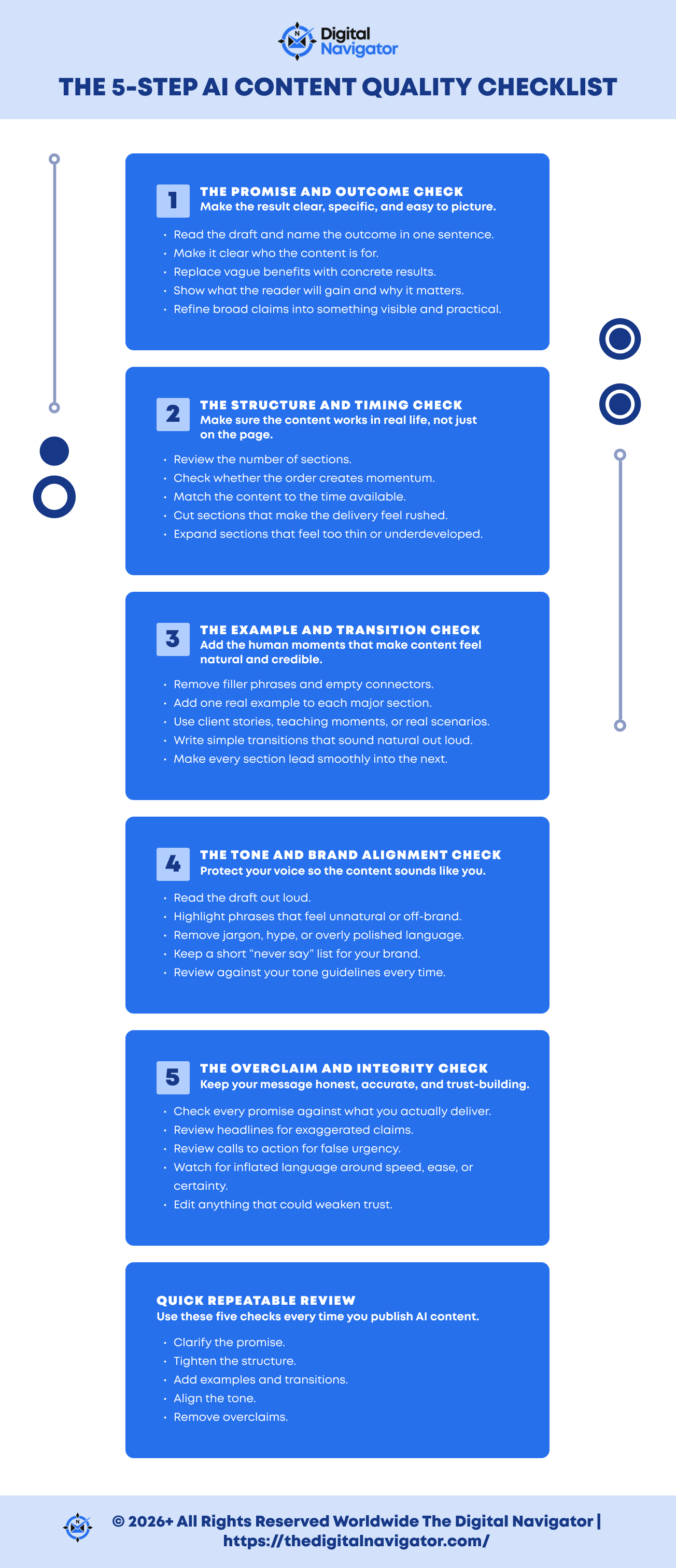
When you run this review, move in order. Each step catches a different kind of drift, and together they create a simple system you can use every time you publish AI content.
1. The Promise and Outcome Check
Start with the core promise, because everything else depends on it.
Read the draft and ask yourself whether the outcome is clear in one sentence. A reader should be able to understand what they will gain, why it matters, and whether the content is for them without having to interpret vague phrases like “unlock your potential” or “take your business to the next level.”
This is where AI often sounds polished but noncommittal. It likes broad benefits because broad language is easy to reuse across topics. Your job is to make the outcome concrete.
For example, instead of “learn how to improve your course marketing,” you might refine the promise to “learn how to turn one webinar into a complete funnel with aligned emails, landing page copy, and reminders.”
These little details give the reader something they can picture in their minds.
And if you work in AI course writing, this step matters even more because students need to know what a lesson, module, or training will actually help them do. Clear outcomes create trust long before the teaching begins!
.cp_style_274002 .cp-popup-content {font-family:Verdana;font-style:Normal;font-weight:Normal;}.cp_style_274002 .cp-popup-content{ border-style:none;border-color:#e1e1e1;border-width:1px 1px 1px 1px;border-radius:3px 3px 3px 3px;mobile-breakpoint:767;}.cp_style_274002 #panel-1-274002 .cp-target:hover { }.cp_style_274002 #panel-1-274002 { }.cp_style_274002 .cp-popup-content { width:550px;height:350px;background : #2770ec;background : -webkit-linear-gradient(90deg, #2770ec 47%, #d71439 47%);background : -moz-linear-gradient(90deg, #2770ec 47%, #d71439 47%);background : -ms-linear-gradient(90deg, #2770ec 47%, #d71439 47%);background : -o-linear-gradient(90deg, #2770ec 47%, #d71439 47%);background : linear-gradient(90deg, #2770ec 47%, #d71439 47%);}@media ( max-width: 767px ) {.cp_style_274002 .cp-popup-content{ border-style:none;border-color:#e1e1e1;border-width:1px 1px 1px 1px;border-radius:3px 3px 3px 3px;mobile-breakpoint:767;}.cp_style_274002 #panel-1-274002 .cp-target:hover { }.cp_style_274002 #panel-1-274002 { }.cp_style_274002 .cp-popup-content { width:360px;height:550px;background : #2770ec;background : -webkit-linear-gradient(0deg, #2770ec 49%, #d71439 49%);background : -moz-linear-gradient(0deg, #2770ec 49%, #d71439 49%);background : -ms-linear-gradient(0deg, #2770ec 49%, #d71439 49%);background : -o-linear-gradient(0deg, #2770ec 49%, #d71439 49%);background : linear-gradient(0deg, #2770ec 49%, #d71439 49%);}}.cp_style_274002 .cp-popup .cpro-form .cp-form-input-field{ font-family:inherit;font-style:inherit;font-weight:inherit;text-transform:none;font-size:13px;letter-spacing:0;text-align:left;color:#666;background-color:#fff;border-style:solid;border-width:1px 1px 1px 1px;border-radius:1px 1px 1px 1px;border-color:#bbb;active-border-color:#666;padding:0px 10px 0px 10px;}.cp_style_274002 #form_field-274002 .cp-target:hover { }.cp_style_274002 #form_field-274002 placeholder { color:#666;}.cp_style_274002 .cp-popup .cpro-form .cp-form-input-field input[type=’radio’], .cp_style_274002 .cp-popup .cpro-form .cp-form-input-field input[type=’checkbox’] {color:#666;background-color:#fff;}.cp_style_274002 .cp-popup .cpro-form .cp-form-input-field:focus {border-color: #666;}.cp_style_274002 .cp-popup .cpro-form .cp-form-input-field::-webkit-input-placeholder {color:#666;}.cp_style_274002 .cp-popup .cpro-form .cp-form-input-field::-moz-placeholder {color:#666;}.cp_style_274002 .cp-popup .cpro-form .pika-lendar table tbody button:hover { background :#666;}.cp_style_274002 .cp-popup .cpro-form .pika-lendar table tbody .is-selected .pika-button { background :#666;box-shadow : inset 0 1px 3px #666;}.cp_style_274002 #form_field-274002 { }@media ( max-width: 767px ) {.cp_style_274002 .cp-popup .cpro-form .cp-form-input-field{ font-family:inherit;font-style:inherit;font-weight:inherit;text-transform:none;font-size:8px;letter-spacing:0;text-align:left;color:#666;background-color:#fff;border-style:solid;border-width:1px 1px 1px 1px;border-radius:1px 1px 1px 1px;border-color:#bbb;active-border-color:#666;padding:0px 10px 0px 10px;}.cp_style_274002 #form_field-274002 .cp-target:hover { }.cp_style_274002 #form_field-274002 placeholder { color:#666;}.cp_style_274002 .cp-popup .cpro-form .cp-form-input-field input[type=’radio’], .cp_style_274002 .cp-popup .cpro-form .cp-form-input-field input[type=’checkbox’] {color:#666;background-color:#fff;}.cp_style_274002 .cp-popup .cpro-form .cp-form-input-field:focus {border-color: #666;}.cp_style_274002 .cp-popup .cpro-form .cp-form-input-field::-webkit-input-placeholder {color:#666;}.cp_style_274002 .cp-popup .cpro-form .cp-form-input-field::-moz-placeholder {color:#666;}.cp_style_274002 .cp-popup .cpro-form .pika-lendar table tbody button:hover { background :#666;}.cp_style_274002 .cp-popup .cpro-form .pika-lendar table tbody .is-selected .pika-button { background :#666;box-shadow : inset 0 1px 3px #666;}.cp_style_274002 #form_field-274002 { }}.cp_style_274002 #cp_shape-0-274002 .cp-target { fill:#d71439;stroke-width:2;width:25px;height:38px;}.cp_style_274002 #cp_shape-0-274002 .cp-target:hover { fill:#d71439;}.cp_style_274002 #cp_shape-0-274002 .cp-target { }.cp_style_274002 #cp_shape-0-274002 .cp-target ~ .cp-field-shadow { }.cp_style_274002 #cp_shape-0-274002 { }.cp_style_274002 #cp_shape-0-274002 .cp-rotate-wrap{ transform:rotate( 0deg);}.cp_style_274002 #cp_shape-0-274002 { }.cp_style_274002 #cp_shape-0-274002 { left: 16px;top: 0px;z-index:2;}@media ( max-width: 767px ) {.cp_style_274002 #cp_shape-0-274002 .cp-target { fill:#d71439;stroke-width:2;width:15px;height:22px;}.cp_style_274002 #cp_shape-0-274002 .cp-target:hover { fill:#d71439;}.cp_style_274002 #cp_shape-0-274002 .cp-target { }.cp_style_274002 #cp_shape-0-274002 .cp-target ~ .cp-field-shadow { }.cp_style_274002 #cp_shape-0-274002 { }.cp_style_274002 #cp_shape-0-274002 .cp-rotate-wrap{ transform:rotate( 0deg);}.cp_style_274002 #cp_shape-0-274002 { }.cp_style_274002 #cp_shape-0-274002 { left: 9px;top: 0px;z-index:2;}}.cp_style_274002 #cp_heading-0-274002 .cp-target { font-family:Montserrat;font-style:800;font-weight:800;font-size:24px;line-height:1.2;letter-spacing:0px;text-align:left;color:#ffffff;width:224px;height:86px;}.cp_style_274002 #cp_heading-0-274002 .cp-target:hover { }.cp_style_274002 #cp_heading-0-274002 .cp-rotate-wrap{ transform:rotate( 0deg);}.cp_style_274002 #cp_heading-0-274002 { left: 28px;top: 61px;z-index:3;}@media ( max-width: 767px ) {.cp_style_274002 #cp_heading-0-274002 .cp-target { font-family:Montserrat;font-style:800;font-weight:800;font-size:20px;line-height:1.2;letter-spacing:0px;text-align:center;color:#ffffff;width:315px;height:94px;}.cp_style_274002 #cp_heading-0-274002 .cp-target:hover { }.cp_style_274002 #cp_heading-0-274002 .cp-rotate-wrap{ transform:rotate( 0deg);}.cp_style_274002 #cp_heading-0-274002 { left: 22.5px;top: 305.5px;z-index:3;}}.cp_style_274002 #cp_button-1-274002 .cp-target { font-family:inherit;font-style:Inherit;font-weight:Inherit;font-size:14px;letter-spacing:0px;text-align:center;color:#fff;background:#d71439;width:234px;height:49px;padding:0px 15px 0px 15px;}.cp_style_274002 #cp_button-1-274002 .cp-target:hover { color:#fff;background:#b70b0b;}.cp_style_274002 #cp_button-1-274002 .cp-target { border-style:none;}.cp_style_274002 #cp_button-1-274002 .cp-target ~ .cp-field-shadow { border-style:none;}.cp_style_274002 #cp_button-1-274002 .cp-target { border-color:#757575;}.cp_style_274002 #cp_button-1-274002 .cp-target ~ .cp-field-shadow { border-color:#757575;}.cp_style_274002 #cp_button-1-274002 .cp-target { border-width:1px 1px 1px 1px;}.cp_style_274002 #cp_button-1-274002 .cp-target ~ .cp-field-shadow { border-width:1px 1px 1px 1px;}.cp_style_274002 #cp_button-1-274002 .cp-target { border-radius:0px 0px 0px 0px;}.cp_style_274002 #cp_button-1-274002 .cp-target ~ .cp-field-shadow { border-radius:0px 0px 0px 0px;}.cp_style_274002 #cp_button-1-274002 .cp-target > .cp-close-link { border-radius:0px 0px 0px 0px;}.cp_style_274002 #cp_button-1-274002 .cp-target > .cp-close-image { border-radius:0px 0px 0px 0px;}.cp_style_274002 #cp_button-1-274002 .cp-target { }.cp_style_274002 #cp_button-1-274002 .cp-target ~ .cp-field-shadow { }.cp_style_274002 #cp_button-1-274002 .cp-rotate-wrap{ transform:rotate( 0deg);}.cp_style_274002 #cp_button-1-274002 .cp-target:hover { }.cp_style_274002 #cp_button-1-274002 .cp-target:hover ~ .cp-field-shadow { }.cp_style_274002 #cp_button-1-274002 { left: 14px;top: 246px;z-index:9;}@media ( max-width: 767px ) {.cp_style_274002 #cp_button-1-274002 .cp-target { font-family:inherit;font-style:Inherit;font-weight:Inherit;font-size:14px;letter-spacing:0px;text-align:center;color:#fff;background:#d71439;width:266px;height:67px;padding:0px 15px 0px 15px;}.cp_style_274002 #cp_button-1-274002 .cp-target:hover { color:#fff;background:#b70b0b;}.cp_style_274002 #cp_button-1-274002 .cp-target { border-style:none;}.cp_style_274002 #cp_button-1-274002 .cp-target ~ .cp-field-shadow { border-style:none;}.cp_style_274002 #cp_button-1-274002 .cp-target { border-color:#757575;}.cp_style_274002 #cp_button-1-274002 .cp-target ~ .cp-field-shadow { border-color:#757575;}.cp_style_274002 #cp_button-1-274002 .cp-target { border-width:1px 1px 1px 1px;}.cp_style_274002 #cp_button-1-274002 .cp-target ~ .cp-field-shadow { border-width:1px 1px 1px 1px;}.cp_style_274002 #cp_button-1-274002 .cp-target { border-radius:0px 0px 0px 0px;}.cp_style_274002 #cp_button-1-274002 .cp-target ~ .cp-field-shadow { border-radius:0px 0px 0px 0px;}.cp_style_274002 #cp_button-1-274002 .cp-target > .cp-close-link { border-radius:0px 0px 0px 0px;}.cp_style_274002 #cp_button-1-274002 .cp-target > .cp-close-image { border-radius:0px 0px 0px 0px;}.cp_style_274002 #cp_button-1-274002 .cp-target { }.cp_style_274002 #cp_button-1-274002 .cp-target ~ .cp-field-shadow { }.cp_style_274002 #cp_button-1-274002 .cp-rotate-wrap{ transform:rotate( 0deg);}.cp_style_274002 #cp_button-1-274002 .cp-target:hover { }.cp_style_274002 #cp_button-1-274002 .cp-target:hover ~ .cp-field-shadow { }.cp_style_274002 #cp_button-1-274002 { left: 47px;top: 441px;z-index:9;}}.cp_style_274002 #cp_sub_heading-0-274002 .cp-target { font-family:Montserrat;font-style:Inherit;font-weight:Inherit;font-size:16px;line-height:1.3;letter-spacing:0px;text-align:left;color:#ffffff;width:212px;height:68px;}.cp_style_274002 #cp_sub_heading-0-274002 .cp-target:hover { }.cp_style_274002 #cp_sub_heading-0-274002 .cp-rotate-wrap{ transform:rotate( 0deg);}.cp_style_274002 #cp_sub_heading-0-274002 { left: 25px;top: 165px;z-index:10;}@media ( max-width: 767px ) {.cp_style_274002 #cp_sub_heading-0-274002 .cp-target { font-family:Montserrat;font-style:Inherit;font-weight:Inherit;font-size:16px;line-height:1.3;letter-spacing:0px;text-align:center;color:#ffffff;width:286px;height:92px;}.cp_style_274002 #cp_sub_heading-0-274002 .cp-target:hover { }.cp_style_274002 #cp_sub_heading-0-274002 .cp-rotate-wrap{ transform:rotate( 0deg);}.cp_style_274002 #cp_sub_heading-0-274002 { left: 37px;top: 363px;z-index:10;}}.cp_style_274002 #cp_image-1-274002 .cp-target { width:265px;height:244px;}.cp_style_274002 #cp_image-1-274002 .cp-target:hover { }.cp_style_274002 #cp_image-1-274002 .cp-target { border-style:none;}.cp_style_274002 #cp_image-1-274002 .cp-target ~ .cp-field-shadow { border-style:none;}.cp_style_274002 #cp_image-1-274002 .cp-target { border-color:#757575;}.cp_style_274002 #cp_image-1-274002 .cp-target ~ .cp-field-shadow { border-color:#757575;}.cp_style_274002 #cp_image-1-274002 .cp-target { border-width:1px 1px 1px 1px;}.cp_style_274002 #cp_image-1-274002 .cp-target ~ .cp-field-shadow { border-width:1px 1px 1px 1px;}.cp_style_274002 #cp_image-1-274002 .cp-target { border-radius:0px 0px 0px 0px;}.cp_style_274002 #cp_image-1-274002 .cp-target ~ .cp-field-shadow { border-radius:0px 0px 0px 0px;}.cp_style_274002 #cp_image-1-274002 .cp-target > .cp-close-link { border-radius:0px 0px 0px 0px;}.cp_style_274002 #cp_image-1-274002 .cp-target > .cp-close-image { border-radius:0px 0px 0px 0px;}.cp_style_274002 #cp_image-1-274002 .cp-target { }.cp_style_274002 #cp_image-1-274002 .cp-target ~ .cp-field-shadow { }.cp_style_274002 #cp_image-1-274002 .cp-rotate-wrap{ transform:rotate( 0deg);}.cp_style_274002 #cp_image-1-274002 .cp-target:hover { }.cp_style_274002 #cp_image-1-274002 .cp-target:hover ~ .cp-field-shadow { }.cp_style_274002 #cp_image-1-274002 { left: 274.5px;top: 53px;z-index:11;}@media ( max-width: 767px ) {.cp_style_274002 #cp_image-1-274002 .cp-target { width:298px;height:231px;}.cp_style_274002 #cp_image-1-274002 .cp-target:hover { }.cp_style_274002 #cp_image-1-274002 .cp-target { border-style:none;}.cp_style_274002 #cp_image-1-274002 .cp-target ~ .cp-field-shadow { border-style:none;}.cp_style_274002 #cp_image-1-274002 .cp-target { border-color:#757575;}.cp_style_274002 #cp_image-1-274002 .cp-target ~ .cp-field-shadow { border-color:#757575;}.cp_style_274002 #cp_image-1-274002 .cp-target { border-width:1px 1px 1px 1px;}.cp_style_274002 #cp_image-1-274002 .cp-target ~ .cp-field-shadow { border-width:1px 1px 1px 1px;}.cp_style_274002 #cp_image-1-274002 .cp-target { border-radius:0px 0px 0px 0px;}.cp_style_274002 #cp_image-1-274002 .cp-target ~ .cp-field-shadow { border-radius:0px 0px 0px 0px;}.cp_style_274002 #cp_image-1-274002 .cp-target > .cp-close-link { border-radius:0px 0px 0px 0px;}.cp_style_274002 #cp_image-1-274002 .cp-target > .cp-close-image { border-radius:0px 0px 0px 0px;}.cp_style_274002 #cp_image-1-274002 .cp-target { }.cp_style_274002 #cp_image-1-274002 .cp-target ~ .cp-field-shadow { }.cp_style_274002 #cp_image-1-274002 .cp-rotate-wrap{ transform:rotate( 0deg);}.cp_style_274002 #cp_image-1-274002 .cp-target:hover { }.cp_style_274002 #cp_image-1-274002 .cp-target:hover ~ .cp-field-shadow { }.cp_style_274002 #cp_image-1-274002 { left: 31px;top: 25px;z-index:11;}}@media ( max-width: 767px ) {.cp_style_274002 .cp-invisible-on-mobile {display: none !important;}}
Take free AI course writing masterclass
Speed up course creation by crafting your own AI agent.

2. The Structure and Timing Check
This step is especially important for webinars, workshops, and training-based content.
A draft can look tidy on the page and still collapse under real-world timing. We review this often with course creators who use AI to outline live sessions. The model tends to keep adding sections because more structure looks more complete. The problem only becomes obvious when you imagine speaking it aloud.
Our advice is to look at the number of sections, the order they appear in, and the time available.
A 25-minute webinar with ten major sections will almost always feel rushed.
On the other end, three vague sections can leave the session feeling thin and underdeveloped. A stronger draft usually lands somewhere in the middle, with enough shape to create momentum, and enough breathing room for examples and transitions.
This is where an AI course checker can be surprisingly helpful as a mindset, even if the “checker” is simply you or a team member reviewing the draft with a sharper eye.
Remember, you are checking whether the teaching can actually be delivered with clarity, not whether it merely looks organized on paper.
3. The Example and Transition Check

AI is good at producing complete paragraphs. It is much less reliable at knowing where a real example would strengthen trust or where a transition should sound like something a person would naturally say.
So here’s the fastest way we’ve learned to make AI-generated content sound more human:
Look for empty connectors such as “As we can see,” “In today’s world,” or “It is important to note.” These phrases are often harmless, but they rarely add anything. They can make a draft feel padded, especially in spoken content.
Then look for places where a real example belongs. A short story from a client project, a moment from your own business, or a concrete teaching scenario can change the temperature of the draft immediately.
One practical habit that also helps here is, for every major section, add one example and one natural bridge into the next idea. That single pass often does more for quality than rewriting entire pages.
4. The Tone and Brand Alignment Check
This is the part of the review that protects your voice, and stops your ideas from becoming written in ChatGPT-speak. Here’s what we do:
Read the draft out loud and pay attention to the phrases that feel foreign in your mouth. Most educators can spot this quickly once they slow down. The sentence may be grammatically correct, but it may still sound unlike you.
You can make this easier by keeping a short “never say” list. For some businesses, that includes hype-driven phrases. For others, it includes corporate jargon, exaggerated urgency, or language that feels overly polished.
Tone boundaries matter because AI learns from pattern, not from loyalty to your brand. Unless you define those boundaries, the model will borrow from whatever style is most common in the material it has seen.
And for clients who create large amounts of content, we often recommend storing tone guidelines, values, and brand language in one place so every prompt and every review references the same standards. That turns your editorial judgment into something repeatable using the Ai tools at your fingertips.
5. The Overclaim and Integrity Check

This may be the most important step in the entire process.
AI often strengthens claims slightly. It will make the promise a little bigger, the urgency a little sharper, or the expected result a little more sweeping than your actual offer can support.
It does this because stronger claims are common in marketing language, not because it understands the ethical edge you are trying to hold.
So before you publish AI content, read the draft with one question in mind: does this promise more than the training, offer, or page can truly deliver?
For course and membership businesses, and even for businesses who use education as a marketing tool, credibility is built slowly and lost quickly. A modest edit before you hit publish can protect the trust you have worked hard to earn with your audience.
How This Checklist Changes the Way You Publish AI Content
Without a review process, AI can feel unpredictable. You end up editing in circles, tweaking random sentences, and wondering why the draft still feels off.
It can also feel frustrating when you end up spending the same amount of time (or more!) wrestling with your AI chat-box than it would have taken to write your whole course or content product yourself.
That’s why we had to stop and recommend a simple AI content quality check, so your work becomes much more authentic and true to your initial idea.
To recap then:
You begin with clearer instructions, which improves the draft before it exists. Then you review the output in a fixed sequence: promise, structure, examples, tone, and integrity.
This 20 minute process can literally change the experience of trying to publish AI content.
Instead of spending too many hours reacting to the AI tool’s response, you are refining with intent as soon as you start. The creation process becomes faster because you are no longer guessing where the weakness is, but eradicating it in advance!
(Nice!)
.cp_style_274009 .cp-popup-content {font-family:Verdana;font-style:Normal;font-weight:Normal;}.cp_style_274009 .cp-popup-content{ border-style:none;border-color:#e1e1e1;border-width:1px 1px 1px 1px;border-radius:3px 3px 3px 3px;mobile-breakpoint:767;}.cp_style_274009 #panel-1-274009 .cp-target:hover { }.cp_style_274009 #panel-1-274009 { }.cp_style_274009 .cp-popup-content { width:550px;height:400px;background : #2770ec;background : -webkit-linear-gradient(90deg, #2770ec 47%, #d71439 47%);background : -moz-linear-gradient(90deg, #2770ec 47%, #d71439 47%);background : -ms-linear-gradient(90deg, #2770ec 47%, #d71439 47%);background : -o-linear-gradient(90deg, #2770ec 47%, #d71439 47%);background : linear-gradient(90deg, #2770ec 47%, #d71439 47%);}@media ( max-width: 767px ) {.cp_style_274009 .cp-popup-content{ border-style:none;border-color:#e1e1e1;border-width:1px 1px 1px 1px;border-radius:3px 3px 3px 3px;mobile-breakpoint:767;}.cp_style_274009 #panel-1-274009 .cp-target:hover { }.cp_style_274009 #panel-1-274009 { }.cp_style_274009 .cp-popup-content { width:360px;height:550px;background : #2770ec;background : -webkit-linear-gradient(0deg, #2770ec 49%, #d71439 49%);background : -moz-linear-gradient(0deg, #2770ec 49%, #d71439 49%);background : -ms-linear-gradient(0deg, #2770ec 49%, #d71439 49%);background : -o-linear-gradient(0deg, #2770ec 49%, #d71439 49%);background : linear-gradient(0deg, #2770ec 49%, #d71439 49%);}}.cp_style_274009 .cp-popup .cpro-form .cp-form-input-field{ font-family:inherit;font-style:inherit;font-weight:inherit;text-transform:none;font-size:13px;letter-spacing:0;text-align:left;color:#666;background-color:#fff;border-style:solid;border-width:1px 1px 1px 1px;border-radius:1px 1px 1px 1px;border-color:#bbb;active-border-color:#666;padding:0px 10px 0px 10px;}.cp_style_274009 #form_field-274009 .cp-target:hover { }.cp_style_274009 #form_field-274009 placeholder { color:#666;}.cp_style_274009 .cp-popup .cpro-form .cp-form-input-field input[type=’radio’], .cp_style_274009 .cp-popup .cpro-form .cp-form-input-field input[type=’checkbox’] {color:#666;background-color:#fff;}.cp_style_274009 .cp-popup .cpro-form .cp-form-input-field:focus {border-color: #666;}.cp_style_274009 .cp-popup .cpro-form .cp-form-input-field::-webkit-input-placeholder {color:#666;}.cp_style_274009 .cp-popup .cpro-form .cp-form-input-field::-moz-placeholder {color:#666;}.cp_style_274009 .cp-popup .cpro-form .pika-lendar table tbody button:hover { background :#666;}.cp_style_274009 .cp-popup .cpro-form .pika-lendar table tbody .is-selected .pika-button { background :#666;box-shadow : inset 0 1px 3px #666;}.cp_style_274009 #form_field-274009 { }@media ( max-width: 767px ) {.cp_style_274009 .cp-popup .cpro-form .cp-form-input-field{ font-family:inherit;font-style:inherit;font-weight:inherit;text-transform:none;font-size:8px;letter-spacing:0;text-align:left;color:#666;background-color:#fff;border-style:solid;border-width:1px 1px 1px 1px;border-radius:1px 1px 1px 1px;border-color:#bbb;active-border-color:#666;padding:0px 10px 0px 10px;}.cp_style_274009 #form_field-274009 .cp-target:hover { }.cp_style_274009 #form_field-274009 placeholder { color:#666;}.cp_style_274009 .cp-popup .cpro-form .cp-form-input-field input[type=’radio’], .cp_style_274009 .cp-popup .cpro-form .cp-form-input-field input[type=’checkbox’] {color:#666;background-color:#fff;}.cp_style_274009 .cp-popup .cpro-form .cp-form-input-field:focus {border-color: #666;}.cp_style_274009 .cp-popup .cpro-form .cp-form-input-field::-webkit-input-placeholder {color:#666;}.cp_style_274009 .cp-popup .cpro-form .cp-form-input-field::-moz-placeholder {color:#666;}.cp_style_274009 .cp-popup .cpro-form .pika-lendar table tbody button:hover { background :#666;}.cp_style_274009 .cp-popup .cpro-form .pika-lendar table tbody .is-selected .pika-button { background :#666;box-shadow : inset 0 1px 3px #666;}.cp_style_274009 #form_field-274009 { }}.cp_style_274009 #cp_shape-0-274009 .cp-target { fill:#d71439;stroke-width:2;width:25px;height:38px;}.cp_style_274009 #cp_shape-0-274009 .cp-target:hover { fill:#d71439;}.cp_style_274009 #cp_shape-0-274009 .cp-target { }.cp_style_274009 #cp_shape-0-274009 .cp-target ~ .cp-field-shadow { }.cp_style_274009 #cp_shape-0-274009 { }.cp_style_274009 #cp_shape-0-274009 .cp-rotate-wrap{ transform:rotate( 0deg);}.cp_style_274009 #cp_shape-0-274009 { }.cp_style_274009 #cp_shape-0-274009 { left: 16px;top: 0px;z-index:2;}@media ( max-width: 767px ) {.cp_style_274009 #cp_shape-0-274009 .cp-target { fill:#d71439;stroke-width:2;width:15px;height:22px;}.cp_style_274009 #cp_shape-0-274009 .cp-target:hover { fill:#d71439;}.cp_style_274009 #cp_shape-0-274009 .cp-target { }.cp_style_274009 #cp_shape-0-274009 .cp-target ~ .cp-field-shadow { }.cp_style_274009 #cp_shape-0-274009 { }.cp_style_274009 #cp_shape-0-274009 .cp-rotate-wrap{ transform:rotate( 0deg);}.cp_style_274009 #cp_shape-0-274009 { }.cp_style_274009 #cp_shape-0-274009 { left: 9px;top: 0px;z-index:2;}}.cp_style_274009 #cp_heading-0-274009 .cp-target { font-family:Montserrat;font-style:800;font-weight:800;font-size:24px;line-height:1.2;letter-spacing:0px;text-align:left;color:#ffffff;width:229px;height:119px;}.cp_style_274009 #cp_heading-0-274009 .cp-target:hover { }.cp_style_274009 #cp_heading-0-274009 .cp-rotate-wrap{ transform:rotate( 0deg);}.cp_style_274009 #cp_heading-0-274009 { left: 17.5px;top: 51.5px;z-index:3;}@media ( max-width: 767px ) {.cp_style_274009 #cp_heading-0-274009 .cp-target { font-family:Montserrat;font-style:800;font-weight:800;font-size:20px;line-height:1.2;letter-spacing:0px;text-align:center;color:#ffffff;width:315px;height:94px;}.cp_style_274009 #cp_heading-0-274009 .cp-target:hover { }.cp_style_274009 #cp_heading-0-274009 .cp-rotate-wrap{ transform:rotate( 0deg);}.cp_style_274009 #cp_heading-0-274009 { left: 22.5px;top: 297.5px;z-index:3;}}.cp_style_274009 #cp_button-1-274009 .cp-target { font-family:inherit;font-style:Inherit;font-weight:Inherit;font-size:14px;letter-spacing:0px;text-align:center;color:#fff;background:#d71439;width:234px;height:49px;padding:0px 15px 0px 15px;}.cp_style_274009 #cp_button-1-274009 .cp-target:hover { color:#fff;background:#b70b0b;}.cp_style_274009 #cp_button-1-274009 .cp-target { border-style:none;}.cp_style_274009 #cp_button-1-274009 .cp-target ~ .cp-field-shadow { border-style:none;}.cp_style_274009 #cp_button-1-274009 .cp-target { border-color:#757575;}.cp_style_274009 #cp_button-1-274009 .cp-target ~ .cp-field-shadow { border-color:#757575;}.cp_style_274009 #cp_button-1-274009 .cp-target { border-width:1px 1px 1px 1px;}.cp_style_274009 #cp_button-1-274009 .cp-target ~ .cp-field-shadow { border-width:1px 1px 1px 1px;}.cp_style_274009 #cp_button-1-274009 .cp-target { border-radius:0px 0px 0px 0px;}.cp_style_274009 #cp_button-1-274009 .cp-target ~ .cp-field-shadow { border-radius:0px 0px 0px 0px;}.cp_style_274009 #cp_button-1-274009 .cp-target > .cp-close-link { border-radius:0px 0px 0px 0px;}.cp_style_274009 #cp_button-1-274009 .cp-target > .cp-close-image { border-radius:0px 0px 0px 0px;}.cp_style_274009 #cp_button-1-274009 .cp-target { }.cp_style_274009 #cp_button-1-274009 .cp-target ~ .cp-field-shadow { }.cp_style_274009 #cp_button-1-274009 .cp-rotate-wrap{ transform:rotate( 0deg);}.cp_style_274009 #cp_button-1-274009 .cp-target:hover { }.cp_style_274009 #cp_button-1-274009 .cp-target:hover ~ .cp-field-shadow { }.cp_style_274009 #cp_button-1-274009 { left: 12.5px;top: 288.5px;z-index:9;}@media ( max-width: 767px ) {.cp_style_274009 #cp_button-1-274009 .cp-target { font-family:inherit;font-style:Inherit;font-weight:Inherit;font-size:14px;letter-spacing:0px;text-align:center;color:#fff;background:#d71439;width:267px;height:70px;padding:0px 15px 0px 15px;}.cp_style_274009 #cp_button-1-274009 .cp-target:hover { color:#fff;background:#b70b0b;}.cp_style_274009 #cp_button-1-274009 .cp-target { border-style:none;}.cp_style_274009 #cp_button-1-274009 .cp-target ~ .cp-field-shadow { border-style:none;}.cp_style_274009 #cp_button-1-274009 .cp-target { border-color:#757575;}.cp_style_274009 #cp_button-1-274009 .cp-target ~ .cp-field-shadow { border-color:#757575;}.cp_style_274009 #cp_button-1-274009 .cp-target { border-width:1px 1px 1px 1px;}.cp_style_274009 #cp_button-1-274009 .cp-target ~ .cp-field-shadow { border-width:1px 1px 1px 1px;}.cp_style_274009 #cp_button-1-274009 .cp-target { border-radius:0px 0px 0px 0px;}.cp_style_274009 #cp_button-1-274009 .cp-target ~ .cp-field-shadow { border-radius:0px 0px 0px 0px;}.cp_style_274009 #cp_button-1-274009 .cp-target > .cp-close-link { border-radius:0px 0px 0px 0px;}.cp_style_274009 #cp_button-1-274009 .cp-target > .cp-close-image { border-radius:0px 0px 0px 0px;}.cp_style_274009 #cp_button-1-274009 .cp-target { }.cp_style_274009 #cp_button-1-274009 .cp-target ~ .cp-field-shadow { }.cp_style_274009 #cp_button-1-274009 .cp-rotate-wrap{ transform:rotate( 0deg);}.cp_style_274009 #cp_button-1-274009 .cp-target:hover { }.cp_style_274009 #cp_button-1-274009 .cp-target:hover ~ .cp-field-shadow { }.cp_style_274009 #cp_button-1-274009 { left: 46.5px;top: 435px;z-index:9;}}.cp_style_274009 #cp_sub_heading-0-274009 .cp-target { font-family:Montserrat;font-style:Inherit;font-weight:Inherit;font-size:16px;line-height:1.3;letter-spacing:0px;text-align:left;color:#ffffff;width:214px;height:68px;}.cp_style_274009 #cp_sub_heading-0-274009 .cp-target:hover { }.cp_style_274009 #cp_sub_heading-0-274009 .cp-rotate-wrap{ transform:rotate( 0deg);}.cp_style_274009 #cp_sub_heading-0-274009 { left: 16px;top: 186.5px;z-index:10;}@media ( max-width: 767px ) {.cp_style_274009 #cp_sub_heading-0-274009 .cp-target { font-family:Montserrat;font-style:Inherit;font-weight:Inherit;font-size:16px;line-height:1.3;letter-spacing:0px;text-align:center;color:#ffffff;width:286px;height:92px;}.cp_style_274009 #cp_sub_heading-0-274009 .cp-target:hover { }.cp_style_274009 #cp_sub_heading-0-274009 .cp-rotate-wrap{ transform:rotate( 0deg);}.cp_style_274009 #cp_sub_heading-0-274009 { left: 37px;top: 358px;z-index:10;}}.cp_style_274009 #cp_image-1-274009 .cp-target { width:275px;height:179px;}.cp_style_274009 #cp_image-1-274009 .cp-target:hover { }.cp_style_274009 #cp_image-1-274009 .cp-target { border-style:none;}.cp_style_274009 #cp_image-1-274009 .cp-target ~ .cp-field-shadow { border-style:none;}.cp_style_274009 #cp_image-1-274009 .cp-target { border-color:#757575;}.cp_style_274009 #cp_image-1-274009 .cp-target ~ .cp-field-shadow { border-color:#757575;}.cp_style_274009 #cp_image-1-274009 .cp-target { border-width:1px 1px 1px 1px;}.cp_style_274009 #cp_image-1-274009 .cp-target ~ .cp-field-shadow { border-width:1px 1px 1px 1px;}.cp_style_274009 #cp_image-1-274009 .cp-target { border-radius:0px 0px 0px 0px;}.cp_style_274009 #cp_image-1-274009 .cp-target ~ .cp-field-shadow { border-radius:0px 0px 0px 0px;}.cp_style_274009 #cp_image-1-274009 .cp-target > .cp-close-link { border-radius:0px 0px 0px 0px;}.cp_style_274009 #cp_image-1-274009 .cp-target > .cp-close-image { border-radius:0px 0px 0px 0px;}.cp_style_274009 #cp_image-1-274009 .cp-target { }.cp_style_274009 #cp_image-1-274009 .cp-target ~ .cp-field-shadow { }.cp_style_274009 #cp_image-1-274009 .cp-rotate-wrap{ transform:rotate( 0deg);}.cp_style_274009 #cp_image-1-274009 .cp-target:hover { }.cp_style_274009 #cp_image-1-274009 .cp-target:hover ~ .cp-field-shadow { }.cp_style_274009 #cp_image-1-274009 { left: 266px;top: 110.5px;z-index:11;}@media ( max-width: 767px ) {.cp_style_274009 #cp_image-1-274009 .cp-target { width:289px;height:182px;}.cp_style_274009 #cp_image-1-274009 .cp-target:hover { }.cp_style_274009 #cp_image-1-274009 .cp-target { border-style:none;}.cp_style_274009 #cp_image-1-274009 .cp-target ~ .cp-field-shadow { border-style:none;}.cp_style_274009 #cp_image-1-274009 .cp-target { border-color:#757575;}.cp_style_274009 #cp_image-1-274009 .cp-target ~ .cp-field-shadow { border-color:#757575;}.cp_style_274009 #cp_image-1-274009 .cp-target { border-width:1px 1px 1px 1px;}.cp_style_274009 #cp_image-1-274009 .cp-target ~ .cp-field-shadow { border-width:1px 1px 1px 1px;}.cp_style_274009 #cp_image-1-274009 .cp-target { border-radius:0px 0px 0px 0px;}.cp_style_274009 #cp_image-1-274009 .cp-target ~ .cp-field-shadow { border-radius:0px 0px 0px 0px;}.cp_style_274009 #cp_image-1-274009 .cp-target > .cp-close-link { border-radius:0px 0px 0px 0px;}.cp_style_274009 #cp_image-1-274009 .cp-target > .cp-close-image { border-radius:0px 0px 0px 0px;}.cp_style_274009 #cp_image-1-274009 .cp-target { }.cp_style_274009 #cp_image-1-274009 .cp-target ~ .cp-field-shadow { }.cp_style_274009 #cp_image-1-274009 .cp-rotate-wrap{ transform:rotate( 0deg);}.cp_style_274009 #cp_image-1-274009 .cp-target:hover { }.cp_style_274009 #cp_image-1-274009 .cp-target:hover ~ .cp-field-shadow { }.cp_style_274009 #cp_image-1-274009 { left: 35.5px;top: 46px;z-index:11;}}@media ( max-width: 767px ) {.cp_style_274009 .cp-invisible-on-mobile {display: none !important;}}
Hire us to manage your AI content marketing
Minimize your time spent with course creation and publication

Get free advice on your AI-generated content
If you have worked through this checklist, you already have a much stronger process for reviewing AI-assisted drafts.
You now have a clearer way to prompt the tool, a practical review system, and a set of guardrails that protect your voice before anything goes live. That alone can improve the quality of your website copy, emails, course pages, and launch content.
For many course creators and membership owners, this is enough to make AI useful rather than frustrating.
But there is also another layer available once you are ready for it.
For example, we help clients build repeatable AI workflows, train those workflows on their best content, create reusable prompts, and integrate the finished drafts into the websites and marketing systems that support their offers.
So if you have started using AI and want a second set of eyes on what you are producing, book a free consultation with our team. We can review a recent draft, look at where the content is drifting, and identify where a few small changes could make the process more accurate, more on-brand, and far more repeatable.
Always here to help!












0 Comments